Thinking of Selling Your Running Business? Here’s How BuyBiz Can Help You Find the Right Buyer

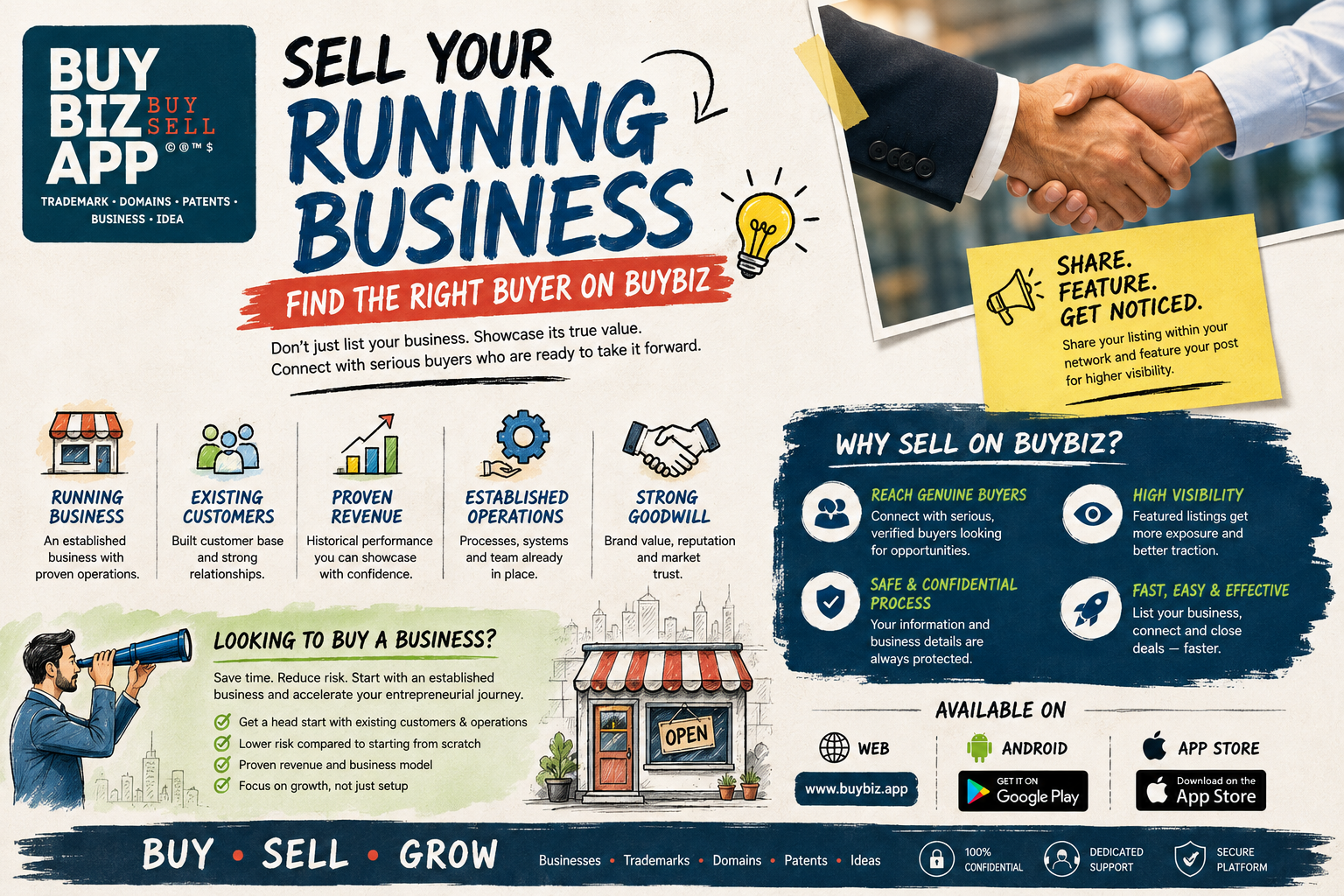
Selling a Running Business? Don't Just Sell It. Showcase Its Value.
Building a business takes years of hard work.
You spend time finding customers, building a reputation, developing processes and creating a brand. So, when you decide to move on, simply closing the business may mean losing much of the value you have created.
This is where selling a running business can make sense.
A running business may already have:
-
Existing customers
-
Regular revenue
-
Employees and systems
-
Supplier relationships
-
Brand recognition
-
Goodwill
-
Website and digital presence
-
Intellectual property
-
Established market presence
For a buyer, this can be much more attractive than starting everything from zero.
Selling Your Business on BuyBiz
If you are planning to sell your business, the first step is to create a clear and attractive listing on BuyBiz.
Don't just write:
"Business for Sale – ₹50 lakh."
Tell the buyer what they are actually getting.
Mention the business history, industry, revenue, profitability, customer base, assets, employees, location, brand, growth opportunities and reason for selling, wherever appropriate.
For example:
"Established 6-year-old bakery with regular customers, trained staff, strong local reputation, existing suppliers and ₹80 lakh annual revenue. Owner looking to move into another venture."
This gives a potential buyer a much better understanding of the opportunity.
Share Your Post Within Your Network
Creating a listing is only the beginning.
Once your business is listed on BuyBiz, share the post within your network.
Your potential buyer could be:
-
A former colleague
-
An entrepreneur
-
An investor
-
Someone already working in your industry
-
A friend or business contact
For example, someone in your network may have always wanted to start a restaurant but doesn't want to spend years building a customer base.
Your running restaurant could be exactly what they are looking for.
Sometimes the right buyer is already within your network.
Feature Your Post for Higher Visibility
If you want your business listing to receive greater exposure, you can consider featuring your post on BuyBiz.
Think of it like putting your business opportunity in a more visible position where more potential buyers can discover it.
However, the goal should not simply be to get more enquiries.
The goal is to get the right buyer.
How Do You Value a Running Business?
One of the biggest questions sellers have is:
"How much is my business worth?"
There is no single formula for every business, but in simple terms, you can think about:
Business Value = Assets + Earning Potential + Goodwill
What is Goodwill?
Goodwill is the value created by things that may not be physically visible.
For example:
Two restaurants have the same furniture and equipment.
Restaurant A has just opened.
Restaurant B has operated successfully for eight years and has thousands of repeat customers, strong reviews and a recognised brand.
Restaurant B may be worth more because the buyer is not just purchasing tables, equipment and inventory.
They are also purchasing reputation, customers, brand value and an established business.
That additional value is broadly referred to as goodwill.
Simple Example
Suppose your business has:
Equipment & other assets: ₹20 lakh
Inventory: ₹5 lakh
Other identifiable assets: ₹5 lakh
Total identifiable assets = ₹30 lakh
But the business is profitable, has loyal customers, a recognised brand and a good market reputation.
A buyer may agree to pay ₹45 lakh.
The additional ₹15 lakh represents the value attributable to factors such as goodwill and earning potential, depending on the valuation method and transaction structure.
Actual valuation should always be based on the business's financials, industry, assets, liabilities, profitability and other relevant factors.
Buying a Running Business: What Should You Check?
Buying an established business can save significant time, but due diligence is essential.
Before purchasing, a buyer should consider:
1. Financials
Check revenue, expenses, profit, cash flow, loans, taxes and outstanding liabilities.
Don't rely only on verbal claims. Verify the numbers.
2. Customers
Understand how many customers the business has and whether they are regular or one-time customers.
Also check whether the business depends heavily on one or two major customers.
3. Brand & IP
Check ownership of the:
-
Trademark
-
Website
-
Domain
-
Software
-
Copyright
-
Other important intellectual property
4. Employees & Operations
Understand who runs the business and whether it depends heavily on the existing owner or a particular employee.
5. Contracts & Legal Issues
Review important customer, supplier, lease, employment and licensing agreements, along with any pending disputes.
6. Reason for Sale
Ask the seller why they are selling.
There may be a perfectly genuine reason such as retirement, relocation or a new business venture. But it is still an important question to ask.
Why Buy a Running Business?
Starting a business requires time.
You need to find customers, hire people, build a brand, establish suppliers and create processes.
When you buy a running business, much of this may already be in place.
In simple terms:
You are not starting from zero.
You may be acquiring an existing customer base, revenue stream, brand, team, systems and market presence.
For an entrepreneur, this can mean saving time and getting a head start.
But remember:
Don't simply buy a business because it is cheap. Buy it because it makes business sense.
BuyBiz: Buy. Sell. Grow.
Whether you are an entrepreneur looking to sell a running business or someone looking for an established business to acquire, the right opportunity can sometimes be closer than you think.
List your business on BuyBiz, share your listing within your network and consider featuring it for higher visibility.
For buyers, explore businesses, understand the opportunity and conduct proper due diligence before making a decision.
A business takes years to build. Make sure its value is visible.
Disclaimer: This article is for general information only and is not legal, financial, tax or investment advice. Buyers and sellers should conduct appropriate professional due diligence before completing a transaction.
© 2026 BuyBiz. All Rights Reserved.
Popular Posts

No Popular Posts Found
We're sorry what you were looking for. please try another way