Our Blogs

Sell Your Social Media Account: Reach Global Buyers with BuyBiz
Your Social Media Presence Can Be a Business Asset
Today, a social media presence can be much more than a profile.
A popular Instagram page, YouTube channel, Facebook business presence, X account, LinkedIn-based business presence or other digital operation may have brand recognition, audience, content, traffic and revenue potential.
For example, imagine someone has spent five years building an Instagram-based fashion business. It has a strong audience, regular customers, brand partnerships and an established online identity.
The owner may eventually want to move on.
Instead of simply abandoning everything, they may explore selling the underlying online business and its transferable assets, where permitted.
This is where BuyBiz can help connect sellers with potential buyers.
But There Is an Important Point About Social Media Accounts
Selling or transferring a social media account is not automatically permitted. Platform rules differ, and some platforms expressly prohibit account sales or transfers or are subject to certain conditions. Therefore, never assume that a social media account can simply be sold by handing over a username and password.
The transaction should be structured around what can legally and contractually be transferred, such as an underlying business, brand, intellectual property, website, domain, content rights, customer relationships and other assets, together with any platform-approved administrative transition.
# Is Your Social Media Audience Worth Money?
Today, many upcoming brands and businesses are actively looking for social media assets with an established audience and large user base. A strong following, high engagement and a relevant audience can have significant commercial value, and businesses may be willing to pay substantial amounts to acquire or gain access to such digital assets or the underlying online business.
So, if you have built a valuable social media presence and are looking to monetise your digital business or transferable social media assets, BuyBiz can help you reach potential buyers beyond your local market. List your opportunity on BuyBiz under the “Social Media and Online Business” category, showcase your audience, engagement, revenue potential and other transferable assets, and reach out to users globally.
Important: Before offering any social media account itself for transfer, always check the applicable platform’s current terms and use only transfer mechanisms that the platform permits. Where direct account transfer is not permitted, you can instead explore selling the underlying online business, brand, website/domain, intellectual property, original content and other transferable business assets.
# How to List Your Social Media Account for Sale on BuyBiz!
1. Describe What You Are Selling
Be clear.
Instead of simply writing:
"Instagram Account for Sale – ₹10 lakh."
Explain the underlying opportunity:
"Established online fashion business with strong Instagram presence, e-commerce website, brand identity, original content library and recurring customer base."
This gives buyers a better understanding of the actual business.
2. Share the following details:
* Follower base
* Engagement Pattern
* Category / Sector / Niche
* Brand collaborations / Monetization Status
* Major expenses
3. Explain the Audience
A buyer should understand whether the audience is relevant and genuine.
For example, 100,000 followers in a highly relevant niche with strong engagement may be more valuable than 500,000 inactive or poorly targeted followers.
4. List Your Digital Assets
Depending on what can legally be transferred, identify assets such as:
* Website and domain
* Trademark
* Copyrighted content
* Product catalogue
* Original photographs and videos
* Brand identity
* E-commerce infrastructure
* Advertising assets
* Business relationships
# How to Reach Global Buyers
Once your listing is live on BuyBiz, you can share the post with your professional and business network.
A good listing should clearly explain:
What is being sold → Why it has value → What the buyer receives → What opportunities exist for growth.
If appropriate, you can also consider featuring your listing on BuyBiz for greater visibility.
A global buyer may be looking for exactly what you have built.
# How to Value a Social Media-Based Business
Don't value it only on follower count.
Consider: Revenue + Profitability + Audience Quality + Brand Value + Intellectual Property + Customer Base + Growth Potential + Goodwill
# Example
Suppose an online beauty business has:
* ₹12 lakh annual revenue
* ₹4 lakh annual profit
* 80,000 relevant followers
* An established website
* Registered trademark
* Original content library
* Repeat customers
Its value is not simply the number of followers.
The buyer may be acquiring an existing business ecosystem.
That is where goodwill and future earning potential can make a significant difference.
# Steps for a Safe Business Transition
Once a buyer and seller agree on a transaction:
1. Verify the assets and ownership.
2. Check the platform's current rules for any account, page, handle or administrator transition.
3. Sign a proper sale/assignment agreement covering the assets and rights being transferred.
4. Complete payment through an agreed and secure mechanism.
5. Transfer permitted assets such as domains, websites, trademarks, copyrights and business systems.
6. Use platform-approved admin or ownership mechanisms wherever available instead of sharing passwords or bypassing platform restrictions.
7. Update email, recovery details and security settings where the platform permits a change.
8. Remove the seller's access after the agreed handover.
9. Protect customer and personal data. Customer information should not simply be handed over without considering applicable privacy and data-protection requirements.
# The Global Opportunity Is Bigger Than Followers
A social media presence can help build a brand, community and business.
But its real value comes from what sits behind the numbers.
If you have built a profitable online business, don't look only at your follower count.
Look at the brand, customers, content, intellectual property, revenue and goodwill you have created.
List the relevant business and transferable digital assets on BuyBiz, reach potential buyers and explore the right opportunity.
Build Your Audience. Build Your Business. Turn Your Digital Value Into Opportunity.
Disclaimer: Social-media platform rules vary and may change. This article is for general information only and is not legal, financial or platform-policy advice. Do not transfer or sell any account where the applicable platform prohibits it.
© 2026 BuyBiz. All Rights Reserved. No part of this article may be reproduced or commercially used without prior written permission.
Read Article
How to Sell or Buy a Patent in India: Easy Guide for Inventors and Businesses
For an inventor, getting a patent is a major achievement.
But a patent can also become a commercial asset.
You may have developed a new machine, manufacturing process, software-related invention or technology, but perhaps you don't have the resources to manufacture or commercialise it yourself.
Instead of leaving the patent unused, you can explore opportunities to sell or license it.
Similarly, a business looking for new technology may find it faster and more practical to buy or license an existing patent rather than develop everything from scratch.
In India, the Patents Act, 1970 permits the patent owner to assign the patent, grant licences or otherwise deal with the patent, subject to the Act.
Selling a Patent: What Does It Mean?
In simple terms, selling a patent generally means transferring ownership or specified rights in the patent to another party.
For example:
Rahul develops a patented technology for reducing energy consumption in industrial machines.
He has the patent, but does not have the manufacturing network to commercialise it.
A manufacturing company sees commercial potential in the invention.
Rahul could explore an assignment of the patent to the company for an agreed consideration.
Alternatively, depending on the business arrangement, he could explore licensing the technology while retaining ownership.
A patent assignment must be in writing and duly executed under Section 68 of the Patents Act. The transfer of title or other interest can also be recorded with the Controller under Section 69.
How to Sell Your Patent on BuyBiz
BuyBiz can help you showcase your patent opportunity to potential buyers.
Step 1: Create Your Listing
Sign in to BuyBiz and select the relevant option to list your Patent/IP asset.
Step 2: Add Important Details
Provide information such as:
- Patent title
- Patent number
- Filing/grant details
- Technology or industry
- Current status
- Remaining patent term
- Key features and potential applications
- Asking price or preferred deal structure
Avoid revealing confidential technical information that could compromise your commercial interests.
Step 3: Explain the Business Opportunity
Don't simply say:
"Patent for Sale – ₹20 lakh."
Explain what problem the invention solves and where it could be commercially useful.
For example:
"Granted patent for an energy-efficient industrial cooling system, suitable for manufacturing and large commercial facilities."
A buyer can immediately understand the potential.
Step 4: Publish and Promote
Once your listing is live, share it within your professional and business network.
You can also consider featuring the listing on BuyBiz if you want greater visibility.
The objective is not just to find a buyer, but to find the right buyer who can commercialise the technology.
What Should a Patent Buyer Check?
Buying a patent is different from buying a normal product.
Before making a decision, a buyer should consider:
- Ownership
Confirm who owns the patent and whether there are co-owners or other recorded interests.
- Patent Status
Check whether the patent is granted, pending, expired, lapsed or subject to any relevant proceedings.
- Remaining Term
In India, a patent generally has a 20-year term from the filing date, subject to applicable provisions and payment of renewal fees.
- Commercial Potential
Ask:
Can this technology actually make money?
A patent may be legally valid but commercially unattractive.
- Existing Licences or Encumbrances
Check whether the patent has already been licensed, assigned, pledged or otherwise encumbered.
- Technical & Legal Due Diligence
Review the patent documents, claims, ownership history, prosecution history and relevant agreements before completing the transaction.
How Much Is a Patent Worth?
There is no fixed price for a patent.
Its value may depend on:
Technology + Market Demand + Remaining Term + Commercial Potential + Competition + Strength of Patent Rights
For example, a patent covering a technology used by a large and growing industry may be more commercially attractive than a patent for a technology with very limited applications.
A ₹5 lakh valuation may be too high for one patent and extremely low for another.
The real question is not "What did it cost to create?" but "What commercial value can it create?"
Why Buy a Patent Instead of Starting From Scratch?
Developing new technology can take years and significant investment.
Buying or licensing an existing patent may give a business access to technology that has already been developed and legally protected.
For example, instead of spending three years developing a new manufacturing process, a company may find an existing patent that fits its requirements and explore acquiring or licensing the relevant rights.
This can potentially save time, development costs and resources—subject, of course, to proper technical and legal due diligence.
Turn Your Innovation Into an Opportunity
A patent should not necessarily remain locked away in a file.
If you are an inventor, startup, company or patent owner with technology that you are not currently commercialising, consider exploring whether there is a buyer or licensee who can take it further.
List your patent on BuyBiz. Share it with your network. Connect with potential buyers.
And if you are looking to acquire technology, explore patent opportunities that could give your business a head start.
Invent. Protect. Connect. Commercialise.
Explore BuyBiz - A One-Of-Kind Platform / App to Buy & Sell Businesses & IPR. All in one.
Disclaimer: General info only. Seek professional advice before any transaction.
© 2026 BuyBiz. All Rights Reserved.
Read Article
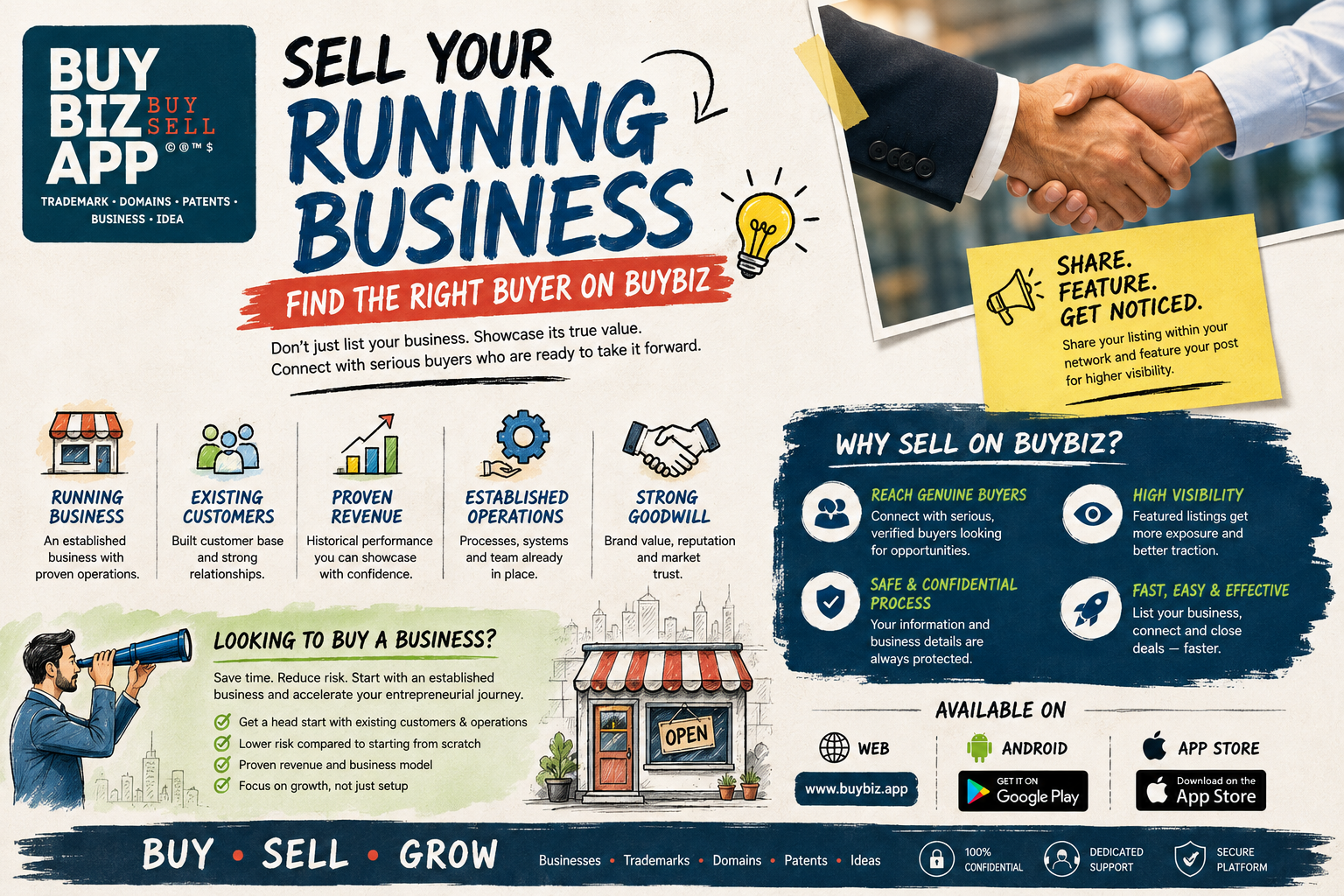
Thinking of Selling Your Running Business? Here’s How BuyBiz Can Help You Find the Right Buyer
Selling a Running Business? Don't Just Sell It. Showcase Its Value.
Building a business takes years of hard work.
You spend time finding customers, building a reputation, developing processes and creating a brand. So, when you decide to move on, simply closing the business may mean losing much of the value you have created.
This is where selling a running business can make sense.
A running business may already have:
-
Existing customers
-
Regular revenue
-
Employees and systems
-
Supplier relationships
-
Brand recognition
-
Goodwill
-
Website and digital presence
-
Intellectual property
-
Established market presence
For a buyer, this can be much more attractive than starting everything from zero.
Selling Your Business on BuyBiz
If you are planning to sell your business, the first step is to create a clear and attractive listing on BuyBiz.
Don't just write:
"Business for Sale – ₹50 lakh."
Tell the buyer what they are actually getting.
Mention the business history, industry, revenue, profitability, customer base, assets, employees, location, brand, growth opportunities and reason for selling, wherever appropriate.
For example:
"Established 6-year-old bakery with regular customers, trained staff, strong local reputation, existing suppliers and ₹80 lakh annual revenue. Owner looking to move into another venture."
This gives a potential buyer a much better understanding of the opportunity.
Share Your Post Within Your Network
Creating a listing is only the beginning.
Once your business is listed on BuyBiz, share the post within your network.
Your potential buyer could be:
-
A former colleague
-
An entrepreneur
-
An investor
-
Someone already working in your industry
-
A friend or business contact
For example, someone in your network may have always wanted to start a restaurant but doesn't want to spend years building a customer base.
Your running restaurant could be exactly what they are looking for.
Sometimes the right buyer is already within your network.
Feature Your Post for Higher Visibility
If you want your business listing to receive greater exposure, you can consider featuring your post on BuyBiz.
Think of it like putting your business opportunity in a more visible position where more potential buyers can discover it.
However, the goal should not simply be to get more enquiries.
The goal is to get the right buyer.
How Do You Value a Running Business?
One of the biggest questions sellers have is:
"How much is my business worth?"
There is no single formula for every business, but in simple terms, you can think about:
Business Value = Assets + Earning Potential + Goodwill
What is Goodwill?
Goodwill is the value created by things that may not be physically visible.
For example:
Two restaurants have the same furniture and equipment.
Restaurant A has just opened.
Restaurant B has operated successfully for eight years and has thousands of repeat customers, strong reviews and a recognised brand.
Restaurant B may be worth more because the buyer is not just purchasing tables, equipment and inventory.
They are also purchasing reputation, customers, brand value and an established business.
That additional value is broadly referred to as goodwill.
Simple Example
Suppose your business has:
Equipment & other assets: ₹20 lakh
Inventory: ₹5 lakh
Other identifiable assets: ₹5 lakh
Total identifiable assets = ₹30 lakh
But the business is profitable, has loyal customers, a recognised brand and a good market reputation.
A buyer may agree to pay ₹45 lakh.
The additional ₹15 lakh represents the value attributable to factors such as goodwill and earning potential, depending on the valuation method and transaction structure.
Actual valuation should always be based on the business's financials, industry, assets, liabilities, profitability and other relevant factors.
Buying a Running Business: What Should You Check?
Buying an established business can save significant time, but due diligence is essential.
Before purchasing, a buyer should consider:
1. Financials
Check revenue, expenses, profit, cash flow, loans, taxes and outstanding liabilities.
Don't rely only on verbal claims. Verify the numbers.
2. Customers
Understand how many customers the business has and whether they are regular or one-time customers.
Also check whether the business depends heavily on one or two major customers.
3. Brand & IP
Check ownership of the:
-
Trademark
-
Website
-
Domain
-
Software
-
Copyright
-
Other important intellectual property
4. Employees & Operations
Understand who runs the business and whether it depends heavily on the existing owner or a particular employee.
5. Contracts & Legal Issues
Review important customer, supplier, lease, employment and licensing agreements, along with any pending disputes.
6. Reason for Sale
Ask the seller why they are selling.
There may be a perfectly genuine reason such as retirement, relocation or a new business venture. But it is still an important question to ask.
Why Buy a Running Business?
Starting a business requires time.
You need to find customers, hire people, build a brand, establish suppliers and create processes.
When you buy a running business, much of this may already be in place.
In simple terms:
You are not starting from zero.
You may be acquiring an existing customer base, revenue stream, brand, team, systems and market presence.
For an entrepreneur, this can mean saving time and getting a head start.
But remember:
Don't simply buy a business because it is cheap. Buy it because it makes business sense.
BuyBiz: Buy. Sell. Grow.
Whether you are an entrepreneur looking to sell a running business or someone looking for an established business to acquire, the right opportunity can sometimes be closer than you think.
List your business on BuyBiz, share your listing within your network and consider featuring it for higher visibility.
For buyers, explore businesses, understand the opportunity and conduct proper due diligence before making a decision.
A business takes years to build. Make sure its value is visible.
Disclaimer: This article is for general information only and is not legal, financial, tax or investment advice. Buyers and sellers should conduct appropriate professional due diligence before completing a transaction.
© 2026 BuyBiz. All Rights Reserved.
Read Article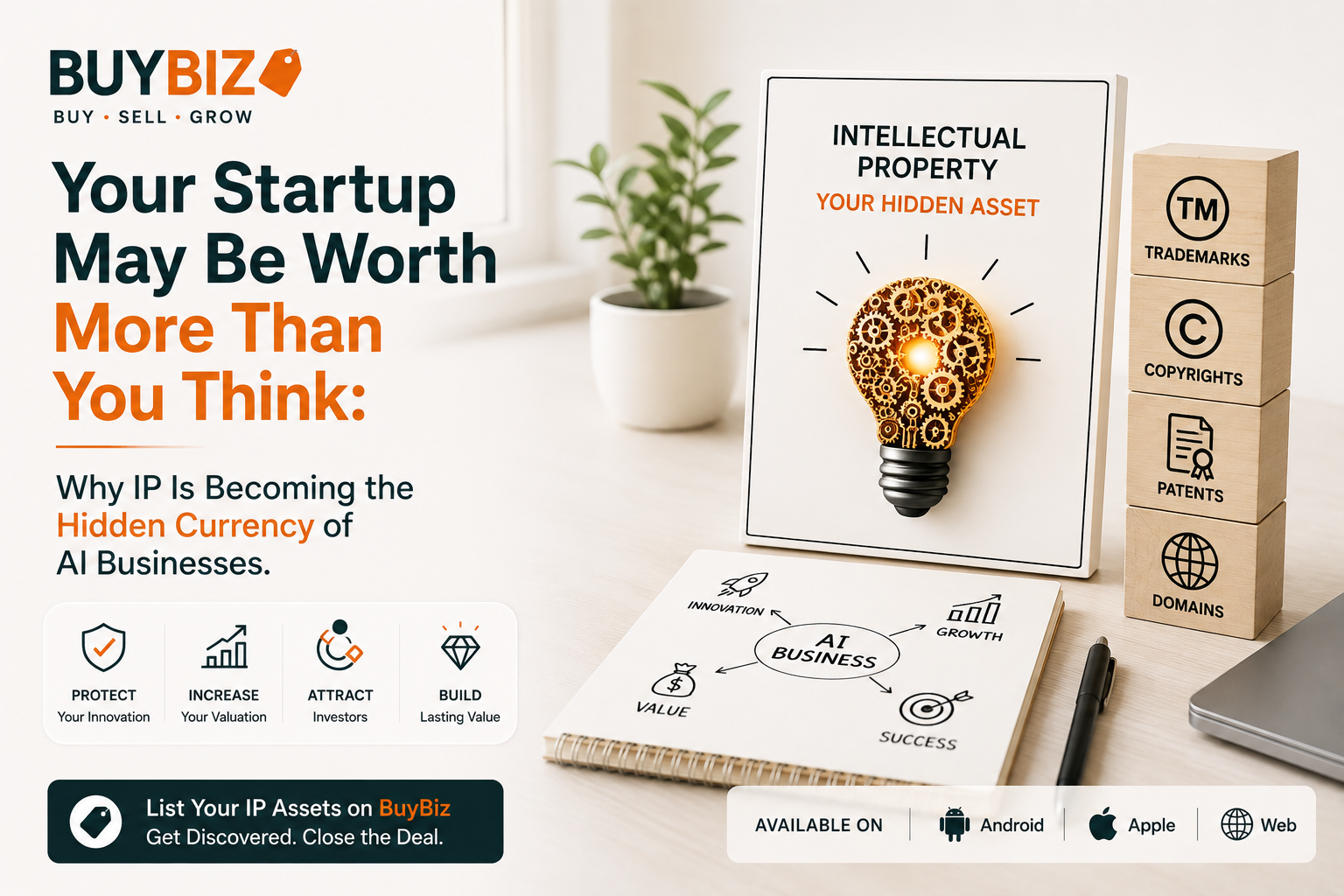
Your Startup May Be Worth More Than You Think: Why IP Is Becoming the Hidden Currency of AI Businesses
Imagine two startups.
Both have ₹5 crore in annual revenue.
Both have 20 employees.
Both have similar customers.
But there is one major difference.
Startup A owns its technology, trademark, software code, proprietary database and several valuable IP assets.
Startup B operates using third-party technology, has an unregistered brand, and has not properly documented ownership of the software created by its employees and freelancers.
Which company would an investor or acquirer prefer?
In many cases, Startup A.
And this is where an important shift is happening in the business world:
Intellectual Property is no longer just a legal asset. It is becoming a business asset, investment asset and M&A asset.
AI Is Making IP Even More Valuable
Artificial intelligence has accelerated the importance of intellectual property.
According to the World Intellectual Property Organization (WIPO), published GenAI patent families increased from around 14,000 in 2023 to more than 37,800 in 2025. WIPO also reported that more than 56,000 GenAI patent families were published during 2024 and 2025 combined.
This tells us something important.
Companies are not simply building AI products.
They are increasingly trying to own the technology behind those products.
That ownership can take different forms:
- Patents
- Trademarks
- Copyright
- Software
- Trade secrets
- Proprietary databases
- Algorithms and technical know-how
- Designs
- Domain names
- Licenses
- Proprietary processes
For an early-stage startup, these assets may not generate immediate revenue.
But they can become extremely valuable when the company raises funding, enters a strategic partnership or becomes an acquisition target.
Think of IP Like the "Property" of a Digital Business
Traditionally, businesses were valued based on physical assets.
A manufacturing company might own:
Land + Factory + Machinery + Inventory
A modern technology company may own:
Software + Brand + Data + Algorithms + Patents + Customer relationships
The second category may look less tangible.
But that doesn't mean it is less valuable.
In fact, for some technology businesses, the opposite can be true.
A startup may operate from a small office with 10 employees but own technology that took years to develop.
That technology can become the most valuable asset on the company's balance sheet from a commercial perspective—even if accounting rules do not reflect its full potential value.
A Simple Example
Let's say Rahul builds an AI-powered legal research platform.
He spends three years developing it.
The company owns:
Brand: "LexPilot"
Software: Proprietary legal research platform
Database: Structured legal information
Technology: Proprietary AI workflow
Trademark: Registered in relevant classes
Copyright: Software and original content
Trade Secrets: Internal processes and proprietary methods
The company generates only ₹1 crore in revenue.
Rahul thinks:
"My company is only worth ₹1 crore because my revenue is ₹1 crore."
An investor may think differently.
The investor may ask:
What exactly am I buying?
If the answer includes valuable proprietary technology, a defensible brand, documented IP ownership and scalable software, the investment story becomes much stronger.
This is why founders should not think of IP registration as simply a compliance exercise.
It is part of building enterprise value.
Why Investors and Acquirers Care About IP
When a company is being acquired, the buyer is not simply purchasing revenue.
The buyer may be purchasing:
- Technology
- Customers
- Brand
- Market access
- Patents
- Software
- Data
- Talent
- Licenses
- Contracts
- Distribution rights
- Intellectual property
This is why IP due diligence has become an important part of technology transactions.
An acquirer may ask:
Who owns the software?
Was it developed by employees?
Freelancers?
External developers?
A technology agency?
If a freelancer developed critical software but the contract does not properly transfer the relevant rights, the buyer may discover a serious ownership problem.
The Freelancer Problem
Consider another example.
A startup hires a developer to build its mobile application.
The developer creates 100% of the code.
The startup pays ₹5 lakh.
The founder assumes:
"I paid for it, therefore I own everything."
Not necessarily.
The contractual position matters.
A well-drafted agreement should clearly address ownership and assignment of relevant intellectual property rights, confidentiality, permitted use, and other applicable rights.
Now imagine the startup is being acquired for ₹50 crore.
During due diligence, the buyer asks:
"Show us the documents establishing ownership of your core software."
The company cannot produce them.
Suddenly, a seemingly small documentation issue becomes a ₹50 crore transaction issue.
This is why IP hygiene should start before a startup becomes valuable.
Your Trademark Can Also Become a Business Asset
Founders often treat trademarks as simply a way to prevent someone else from copying their name.
That's only one part of the story.
A strong brand can become one of the most valuable assets of a company.
Think about a consumer startup.
It may have:
- A registered trademark
- Strong social media presence
- Customer recognition
- Domain names
- Packaging designs
- Copyrighted content
- Distribution relationships
Even if the physical assets are limited, the brand itself can have significant commercial value.
This is particularly important in acquisitions.
A buyer may not want the founder's office.
The buyer may want the brand, customers, technology and IP.
IP Can Create Multiple Exit Opportunities
One of the most interesting developments is that founders don't always have to sell the entire company.
An entrepreneur may potentially explore different transactions involving IP, depending on the rights involved and the commercial structure.
For example:
1. Sell the entire business
The buyer acquires the company and its assets.
2. Sell specific IP
A company may explore selling a particular trademark, patent, copyright or other transferable IP asset.
3. License the IP
The owner retains ownership but allows another business to commercially use the IP in exchange for agreed consideration.
4. Strategic partnership
Two businesses may combine technology, IP and market access.
5. Acquire another business because of its IP
Sometimes the most attractive part of a small company may be its technology or IP rather than its current revenue.
This is one reason the market for buying and selling businesses and intellectual property is becoming increasingly interesting.
The Rise of the "IP-First" Startup
A traditional startup question is:
"How much revenue are you generating?"
An increasingly important question is:
"What do you own?"
Imagine two companies generating the same revenue.
Company A
- Unregistered brand
- Third-party software
- No clear IP assignment
- No patent strategy
- Weak contracts
- No IP inventory
Company B
- Registered trademark
- Proprietary software
- Clear employee/freelancer IP assignments
- Patent portfolio where commercially appropriate
- Documented trade secrets
- Strong licensing agreements
- Clear IP ownership records
Company B may be significantly easier to finance, partner with or acquire.
Revenue tells you what a business earns.
IP can tell you what a business owns and what competitive advantage it may be able to protect.
What Should Founders Do Today?
Every startup should consider creating an IP Asset Inventory.
Start with five questions:
1. What is our brand?
List trademarks, logos, taglines, domain names and important brand assets.
2. What technology do we own?
Identify software, source code, algorithms, databases, technical processes and inventions.
3. Who owns the IP?
Check employment agreements, consultant agreements, developer contracts, licenses and assignments.
4. What should remain confidential?
Identify trade secrets, proprietary information, business processes and confidential datasets.
5. Can our IP generate revenue?
Ask whether the IP could potentially be:
Licensed → Sold → Commercialized → Used in a partnership → Used to support an acquisition
This changes the way founders think about IP.
Instead of asking:
"Do I need to register this?"
Ask:
"Can this IP increase the value of my business?"
IP Is Moving From the Legal Department to the Boardroom
WIPO's 2026 initiatives specifically recognize that AI-driven startups need help identifying, protecting, managing and commercializing assets such as software, data, algorithms and inventions—and connecting IP strategy with investment, partnerships and international expansion.
That is a significant shift.
IP is increasingly becoming part of conversations around:
Fundraising
Startup valuation
Licensing
Joint ventures
Technology transfers
Mergers & acquisitions
International expansion
Business sales
The founder who understands this early may have a meaningful advantage.
The BuyBiz Perspective
At BuyBiz, we believe that businesses and intellectual property should not be viewed only as legal records.
They can be commercial assets.
A trademark may represent a brand.
A patent may represent technology.
A copyright may represent creative value.
A domain may represent digital identity.
A business may represent customers, technology, contracts and market opportunity.
And sometimes, the next big business opportunity is not starting something from zero.
It may be finding an existing business or IP asset and building on it.
That's the idea behind an IP and business marketplace.
Final Takeaway
The next generation of entrepreneurs will not only ask:
"How much money does my business make?"
They will also ask:
"What valuable assets have I built?"
Because in a technology-driven economy, the answer may include things that cannot be physically touched—but can influence investment, licensing, partnerships and acquisitions.
Your trademark.
Your software.
Your patent.
Your database.
Your technology.
Your brand.
Your know-how.
These can become part of your company's economic story.
And the earlier a founder starts treating IP as an asset rather than paperwork, the better positioned the business may be when the opportunity to raise money, expand, license, partner or sell eventually arrives.
Build the business. Protect the IP. Create the asset.
About BuyBiz
BuyBiz is a marketplace focused on buying, selling and discovering businesses and intellectual property assets, including trademarks, copyrights, patents and other business opportunities.
Whether you're an entrepreneur looking to acquire your next opportunity or a business owner looking to unlock value from an asset you've already created, the next opportunity may already exist.
Explore. Discover. Connect. Build.
Explore BuyBiz - A One-Of-Kind Platform / App to Buy & Sell Businesses & IPR. All in one.
Disclaimer: General info only. Seek professional advice before any transaction.
© 2026 BuyBiz. All Rights Reserved.
Read Article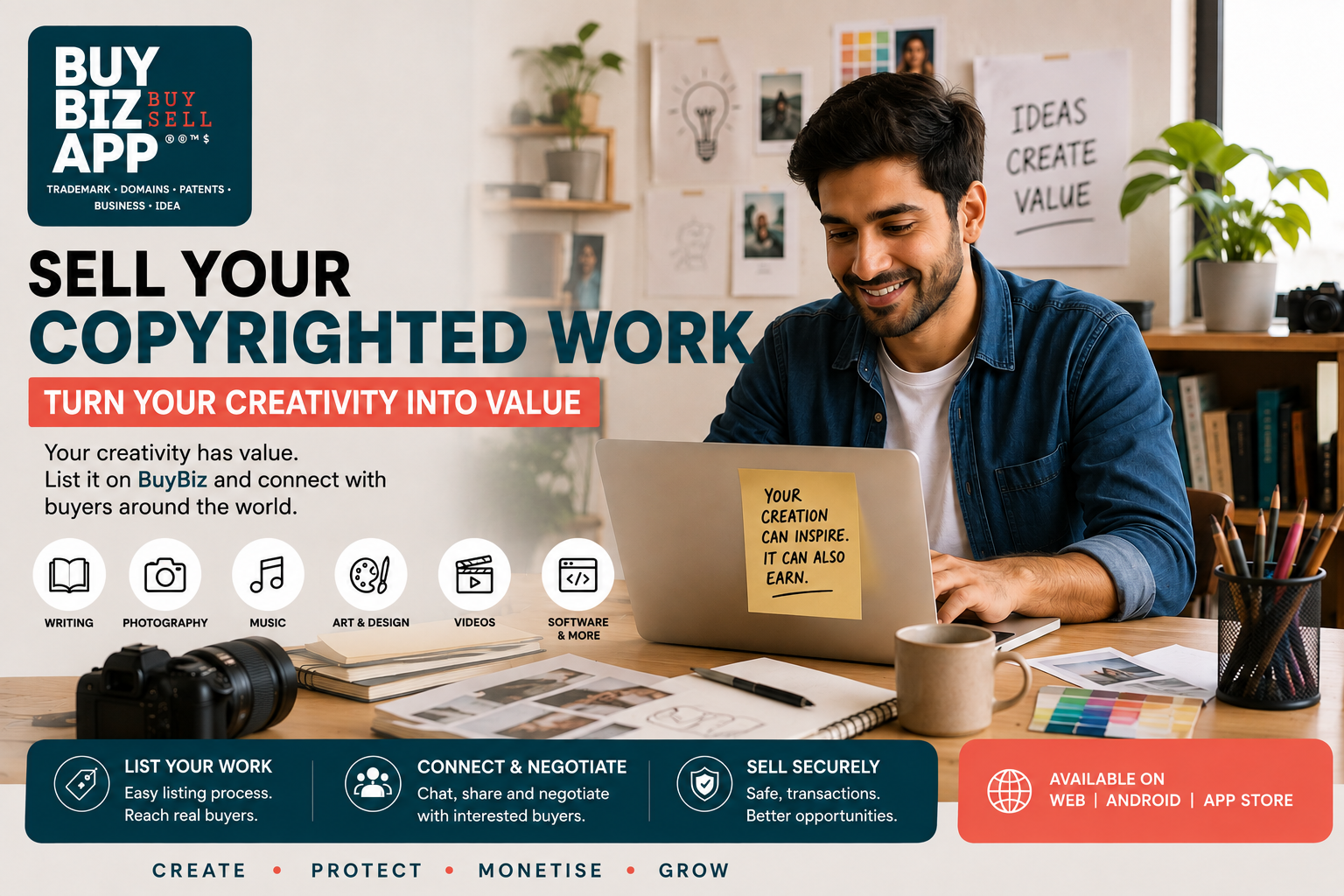
Sell Your Copyrighted Work Online: Turn Your Creativity into Value
Have you ever written a song, painted something unique, or created a logo that people loved — but never thought about earning from it?
Now you can!
Welcome to the world of Copyrights — where your creativity becomes your intellectual property and can open doors to real business opportunities.
💡 What is Copyright?
Copyright is the legal right you automatically get when you create something original — like music, artwork, code, or written content.
It means you own the right to use, sell, or license your creation, and others can’t copy or profit from it without your permission.
Simply put, your ideas are your assets.
✍️ How Can You Create Copyright Material?
Anything you create originally can be protected by copyright, such as:
-
🎵 Songs, music, and jingles
-
🎨 Artwork, illustrations, and logos
-
📖 Stories, poems, or eBooks
-
💻 Apps, code, or software
-
🎬 Videos, short films, or animations
-
🧠 Online courses or presentations
Your imagination has value — protect it and share it smartly.
💰 How to Earn from Copyrighted Work
You can sell your copyright or license it to others for a fee.
For example:
-
A designer can sell a unique logo to a startup.
-
A musician can license background tracks to a YouTuber.
-
A coder can sell their app or website code.
This is how you turn creativity into income.
🚀 Use BuyBiz to Reach the Right Buyers
With BuyBiz, you can list your creative work under the ‘Copyright’ category and connect with people or businesses who value original ideas.
Here’s how:
-
List your work – Share what you’ve created (just a reference or description).
-
Select your price or offer type.
-
Let interested buyers contact you directly.
You’re in control — your creativity, your terms.
⚠️ Important: Protect Your Work
-
Always keep a record of your original creations (like drafts, timestamps, or registration).
-
Do not upload or publish your full original work directly on BuyBiz.
-
Share only references or short samples to attract the right buyers.
-
Discuss and share details at your own discretion and risk.
Your creativity is valuable — protect it before you profit from it.
🌈 Your Hobby Can Be Your Business
Don’t let your creative ideas fade away.
Turn them into an opportunity, income, and a step toward your dream.
✨ List your work under the ‘Copyright’ category on BuyBiz today and connect with the world that appreciates your creativity.
Read Article
List Your Investment Interest & Meet the Right Entrepreneurs Today!
Have you ever dreamed of being a part of an exciting business, owning a brand, or investing in something you truly believe in — but thought it was only for the rich or big venture capitalists?
It’s time to change that mindset. Because today, everyone can be an investor.
💡 The New Age of Everyday Investors
In today’s connected world, opportunities aren’t limited to those with millions to spare. With platforms like BuyBiz, anyone with vision, passion, and some available funds can participate in real businesses, invest in promising startups, or help scale innovative ideas.
You don’t need a corporate background or a big network — you just need the desire to grow alongside people who share your ambition.
🤝 From Dreamer to Investor
Imagine this: You’ve always loved the food industry. You know great taste when you find it, and you’ve dreamed of owning a café someday — but maybe you don’t have the time to start from scratch.
Now, through BuyBiz, you can browse real businesses seeking investors in your area of interest. Whether it’s a local restaurant, a digital brand, or a patented innovation, you can partner, invest, and become part of the growth story.
That’s not just investing — that’s turning your dream into reality.
🌍 Connecting Like-Minded Visionaries
BuyBiz isn’t just a marketplace — it’s a community of entrepreneurs, innovators, and investors.
By listing yourself as a “Be Investor”, you can showcase:
-
The industries you’re interested in
-
Your preferred investment range
-
Your location and business expertise
Entrepreneurs looking for partners or funding can directly connect with you — creating a transparent and meaningful exchange of ideas and opportunities.
It’s not just about money; it’s about collaboration, shared vision, and mutual growth.
🚀 How to Get Started
-
Download the BuyBiz App (available on App Store & Play Store)
-
Create Your Profile under the new category – Be Investor
-
List Your Interests – the sectors, domains, or business types you’d like to invest in
-
Connect Directly with business owners and innovators from across the globe
In just a few steps, you move from being a dreamer to a potential investor — someone who’s shaping the future of businesses.
🌱 Your Dream Investment Awaits
The next big brand, the next tech disruptor, or the café you always wanted to be a part of — could be just a click away.
Join BuyBiz, showcase your interest, and let opportunities find you.
Because on BuyBiz, everyone can be an investor — and every dream deserves a chance to grow.
Start your journey today with BuyBiz!
👉 Buybiz.co.in

How to Sell a Family Business for the Right Value: One Powerful Success Story
Some stories aren’t just about profit — they’re about legacy, grit, and the bittersweet art of letting go.
Meet Rajiv Mehta, a second-generation entrepreneur who turned his family’s modest textile business into a regional powerhouse. For over four decades, the Mehta family stitched their name into the fabric of Mumbai’s garment trade — quite literally. But when Rajiv sold the business last year, he didn’t just walk away with a fortune. He walked away with peace, pride, and the quiet satisfaction of a job well done.
🧵 The Threads of Legacy
Rajiv’s father started Mehta Textiles in the late 1970s with a single sewing machine and a borrowed ₹10,000. The early years were brutal — long hours, missed meals, and relentless hustle. But slowly, the business grew. By the time Rajiv joined in the 1990s, they had a small factory, a loyal customer base, and a reputation for quality.
Rajiv brought in systems, branding, and a touch of modernity. He expanded into retail, built supplier networks, and even launched an in-house label. The business became more than a livelihood — it was the family’s identity.
💔 The Pain of Parting
But as the years passed, the industry changed. Fast fashion, e-commerce, and rising costs began to squeeze margins. Rajiv, now in his late 50s, faced a dilemma: keep fighting the tide or find a graceful exit.
Closing the business felt like betrayal. It wasn’t just about numbers — it was about memories, relationships, and the sweat equity of two generations. But Rajiv knew that clinging to nostalgia could cost him more than money — it could cost him peace.
🤝 The Strategic Sale
Instead of shutting down, Rajiv chose a smarter path: sell the business to someone who could carry the torch forward.
He found a buyer — a young entrepreneur named Neel — who saw value not just in the assets, but in the brand’s goodwill. Neel wanted to pivot Mehta Textiles into sustainable fashion, using its legacy as a launchpad.
The deal was generous. Rajiv received a multi-crore payout, retained a small advisory role, and watched his family name evolve into something new.
💰 The Reward Beyond Money
Yes, Rajiv made a fortune. But the real reward was emotional.
He didn’t have to dismantle what his father built. He didn’t have to lay off loyal workers. He didn’t have to see the shutters come down.
Instead, he saw his legacy reborn — and got paid handsomely for it.
🧠 Lessons for Entrepreneurs
- Legacy has value: A well-run business carries emotional and market goodwill. Don’t underestimate it.
- Exit doesn’t mean failure: Selling can be a strategic win, especially if it preserves what you built.
- Timing is everything: Rajiv sold before burnout, before decline — and that made all the difference.
Don’t just read stories of success — create your own.
👉 Download the BuyBiz App today to list your business for sale or purchase a running business with proven goodwill.
Turn legacy into opportunity. Turn opportunity into wealth.
PS - Based on true story – names are fictionalized for privacy.
Explore BuyBiz - A One-Of-A-Kind Platform / App to Buy & Sell Businesses & IPR. All in one.
Disclaimer: General info only. Seek professional advice before any transaction.
© 2026 BuyBiz. All Rights Reserved.
Read Article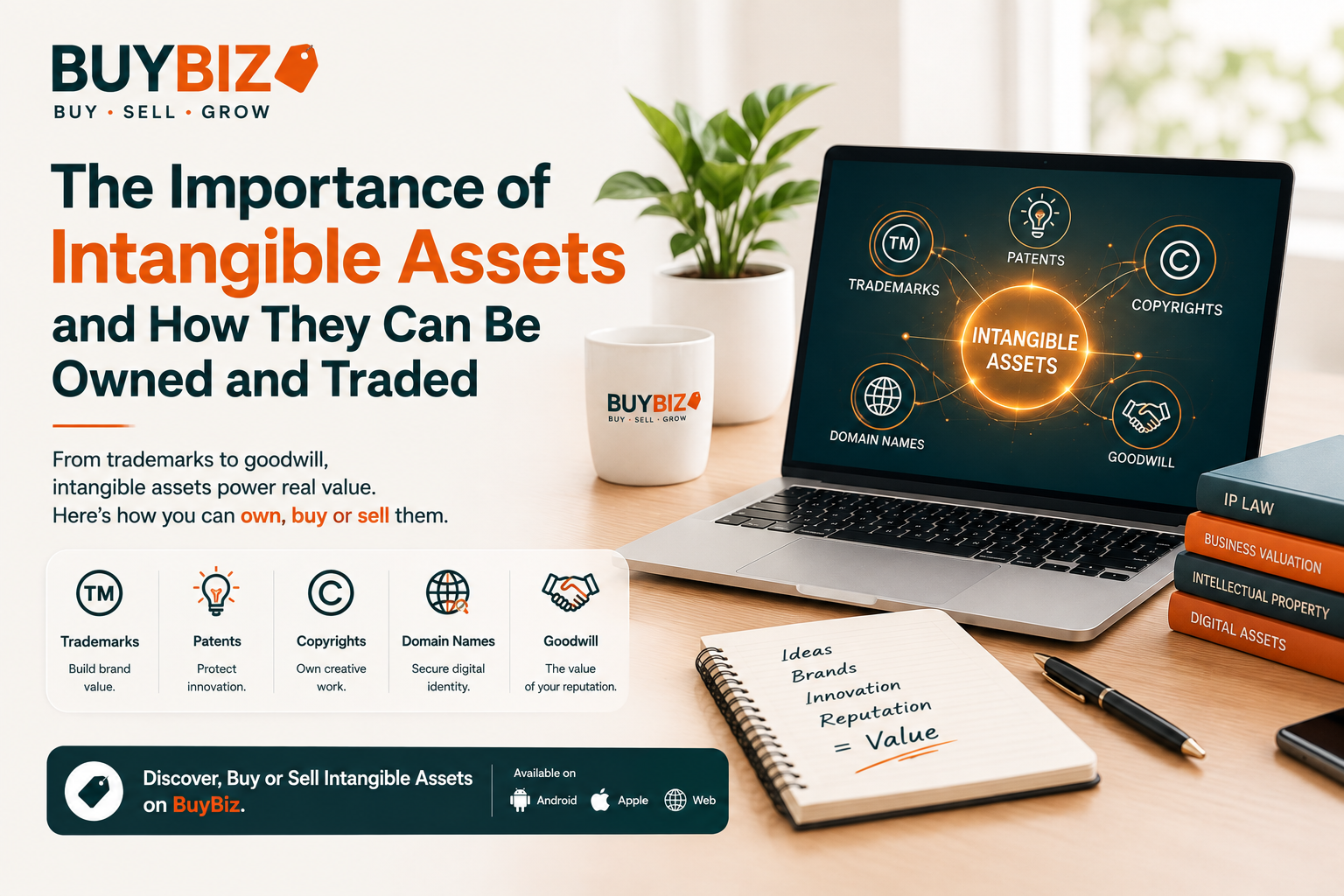
Intangible Assets: What They Are, How You Own Them & How to Buy or Sell Them
Understanding Intangible Assets in the Modern Economy
In today’s fast-paced economy, the real value of a business often lies not in what you can touch, but in what you cannot see. From global giants like Apple and Google to your neighborhood shop, the intangible assets — brand reputation, goodwill, customer loyalty, intellectual property — often outweigh physical assets like land or machinery.
These invisible assets are powerful wealth creators, and with structured ownership and trading mechanisms, they can unlock enormous value for businesses and investors alike.
What Are Intangible Assets?
Defining Intangible vs. Tangible Assets
- Tangible assets: Physical items like buildings, vehicles, and machinery.
- Intangible assets: Non-physical assets such as brand, intellectual property, goodwill, and digital presence.
Key Characteristics of Intangible Assets
- No physical form
- Long-term value creation
- Difficult to measure but critical for valuation
Types of Intangible Assets That Drive Business Value
Intellectual Property (Patents, Copyrights, Trademarks)
These grant legal protection, making innovation and creativity tradeable commodities.
Brand Goodwill and Reputation
The credibility and trust a brand has built over years is a major intangible asset.
Customer Loyalty and Relationships
A loyal customer base ensures recurring revenue and higher business valuation.
Trade Secrets and Proprietary Knowledge
Confidential recipes, formulas, or algorithms (like Coca-Cola’s secret recipe) are priceless.
Digital Assets (Websites, Social Media, Software)
In the digital era, domain names, apps, and social media handles can hold significant value.
Why Intangible Assets Are More Valuable Than Ever
- Knowledge economy dominance: Today’s wealth is built on innovation, ideas, and networks.
- Case studies: Coca-Cola’s brand value far exceeds its physical factories. Apple thrives on innovation and customer loyalty.
- Business valuation: Investors now look at intangible factors more than fixed assets when valuing companies.
How Intangible Assets Are Owned
- Legal Ownership: Through patents, copyrights, and trademarks, businesses gain enforceable rights.
- Licensing Agreements: Businesses can share or rent intangible assets.
- Joint Ventures: Collaborative ownership of intellectual property or brand reputation.
Trading and Monetizing Intangible Assets
- Licensing and Franchising: McDonald’s franchises its brand and systems worldwide.
- Buying and Selling Goodwill: Business sale platforms like BuyBiz.co.in help owners trade goodwill.
- M&A: Companies often acquire businesses mainly for their intangible value.
- Digital Asset Marketplaces: Domains, NFTs, and social media accounts are being traded online.
Challenges in Valuing and Trading Intangible Assets
- Difficult Valuation: Goodwill is subjective.
- Intellectual Property Theft: A global challenge.
- Legal Complexities: Different jurisdictions, varied IP laws.
The Future of Intangible Asset Ownership and Trade
- Tokenization via Blockchain: Assets can be fractionalized and traded securely.
- AI and Data: Emerging as the new “gold” in intangible trading.
- Online Marketplaces: Platforms are growing for IP, digital businesses, and goodwill trading.
Practical Steps for Businesses to Unlock Their Intangible Value
- Protect IP: Register trademarks, patents, and copyrights.
- Build Strong Brand Identity: Reputation is priceless.
- Document Customer Loyalty: Showcase retention data for valuation.
- Prepare for Exit or Investment: Platforms like BuyBiz.co.in make goodwill tradable.
FAQs About Intangible Assets
Q1: Can small businesses monetize intangible assets?
Yes! Small shops with goodwill and loyal customers can trade their business value.
Q2: How do you value goodwill?
Using methods like past earnings, customer loyalty, and brand reputation.
Q3: What is the most valuable intangible asset?
Brand reputation is often the crown jewel.
Q4: Can digital assets be legally owned and sold?
Yes — domains, apps, and even social media accounts can be transferred.
Q5: What role does technology play in trading intangibles?
Blockchain and digital platforms are making asset ownership transparent and tradeable.
Conclusion: Harnessing the Power of Intangible Assets
Intangible assets are no longer invisible — they’re the real drivers of business value. From intellectual property to goodwill, they can be owned, protected, and traded just like physical assets.
For small and large businesses alike, recognizing and monetizing these assets is the key to future wealth creation. Whether you’re a global brand or a local entrepreneur, the power of intangible assets can’t be ignored.
Explore BuyBiz - A One-Of-Kind Platform / App to Buy & Sell Businesses & IPR. All in one.
Disclaimer: General info only. Seek professional advice before any transaction.
© 2026 BuyBiz. All Rights Reserved.
Read Article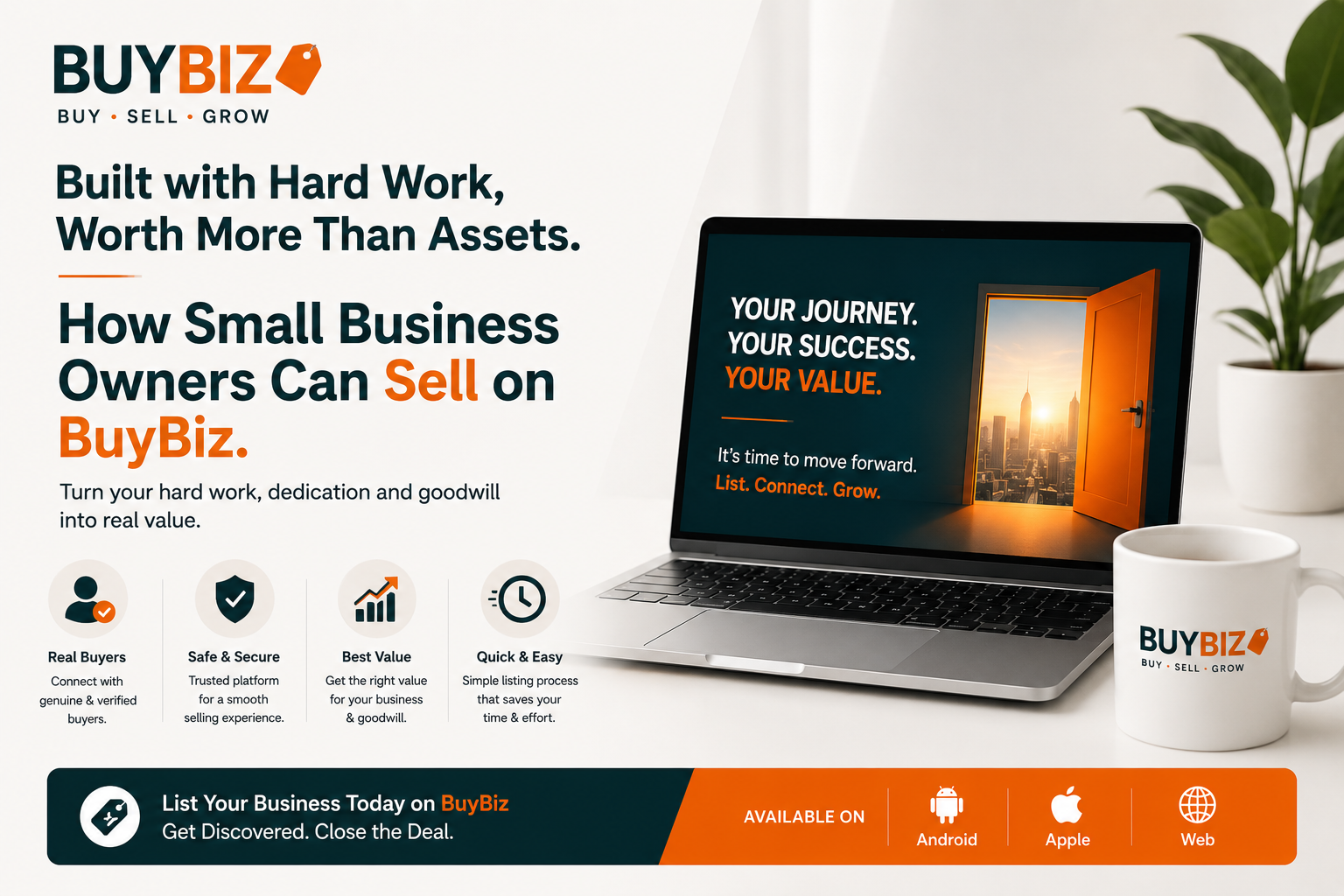
Built with Hard Work, Worth More Than Assets: How Small Business Owners Can Sell on BuyBiz
For decades, small business owners have poured their heart, sweat, and soul into their ventures. From local shops to family-owned restaurants, from service providers to neighborhood stores, these businesses form the backbone of our economy. But when the time comes to move on — whether due to retirement, new opportunities, or personal reasons — most owners struggle to get the true value of their goodwill and hard work.
This is where BuyBiz.co.in steps in as a game-changer, providing a trusted marketplace where small businesses can be sold or invested in, ensuring owners are rewarded fairly for their legacy.
Understanding the Power of Goodwill in Small Businesses
Years of Effort That Create Hidden Business Value
Unlike large corporations, small businesses thrive on community trust, relationships, and goodwill. A tea shop that has served the same locality for 20 years has a loyal customer base that cannot be measured only in numbers.
Why Goodwill Matters More Than Just Financials
Balance sheets may show profits, but goodwill represents reputation, repeat customers, and the credibility built over years. It’s this intangible asset that makes a small business valuable beyond its physical assets.
The Traditional Challenges of Exiting a Small Business
Lack of Buyers Who Understand the Business
Finding the right buyer who appreciates the legacy and customer loyalty of a small business has always been difficult.
Undervaluation of Effort and Legacy
Many small business owners end up selling at a fraction of their worth simply because there’s no structured platform.
Emotional Hurdles in Letting Go
For many owners, their business is like family. Handing it over without assurance of continuity is painful.
BuyBiz.co.in: A Revolutionary Platform for Small Business Sales
What is BuyBiz.co.in?
BuyBiz.co.in is an innovative online platform designed to connect small business owners with genuine buyers and investors.
How It Works for Sellers
Sellers can list their business, highlight its strengths, goodwill, and achievements, and attract the right buyers.
How It Works for Buyers & Investors
Buyers get access to businesses with proven customer bases — businesses they can relate to and grow further.
Key Benefits of Selling Your Business on BuyBiz.co.in
- Unlock True Value: Years of effort and goodwill are fairly recognized.
- Smooth Transition: Buyers can take over seamlessly.
- Reach the Right Audience: Business is showcased to serious buyers & investors.
Why Buyers Love BuyBiz.co.in
- Businesses with a ready market and goodwill.
- Avoids the struggles of starting from scratch.
- A chance to inject new energy and ideas into an established brand.
Step-by-Step Guide to Listing Your Business on BuyBiz.co.in
- Create an account on BuyBiz.co.in.
- List your business (industry, turnover, location).
- Describe by showcasing goodwill, customer base & achievements.
- Connect with interested buyers or investors.
Success Stories: Small Businesses That Found New Life
- A family-owned restaurant sold on BuyBiz.co.in is now scaling into new cities.
- A local retail store transformed into a regional chain after being acquired.
Tips for Maximizing the Sale Value of Your Business
- Document your customer loyalty and history.
- Highlight the brand reputation and goodwill.
- Provide a clear roadmap for business continuity.
FAQs About Selling on BuyBiz.co.in
Q1: Who can list a business on BuyBiz.co.in?
Any small business owner looking to sell or invite investors.
Q2: How does BuyBiz.co.in ensure fair value?
Through structured listings and exposure to genuine buyers.
Q3: What types of businesses are most suitable?
Retail shops, restaurants, service providers, manufacturing units, etc.
Q4: How long does it take to sell?
It varies, but businesses with strong goodwill tend to sell faster.
Q5: Is BuyBiz.co.in only for Indian businesses?
Currently, the focus is on Indian businesses, but it may expand in future.
Q6: What happens after a sale is completed?
Ownership transitions smoothly, with goodwill and assets transferred to the new owner.
Small businesses are built with passion, sweat, and goodwill. For years, owners had no way to monetize this legacy properly. Thanks to BuyBiz.co.in, business owners can now unlock the true value of their work, while buyers step into a ready-made opportunity with loyal customers and growth potential.
👉 If you’ve been thinking of moving on or simply want to cash in on your hard work, it’s time to list your business on BuyBiz and unlock the value today!
Download the BuyBiz App or Visit our Website today!
🌐 Website: www.buybiz.co.in
📲 Download App: Android iOS
Disclaimer: General info only. Seek professional advice before any transaction.
© 2026 BuyBiz. All Rights Reserved.
Read Article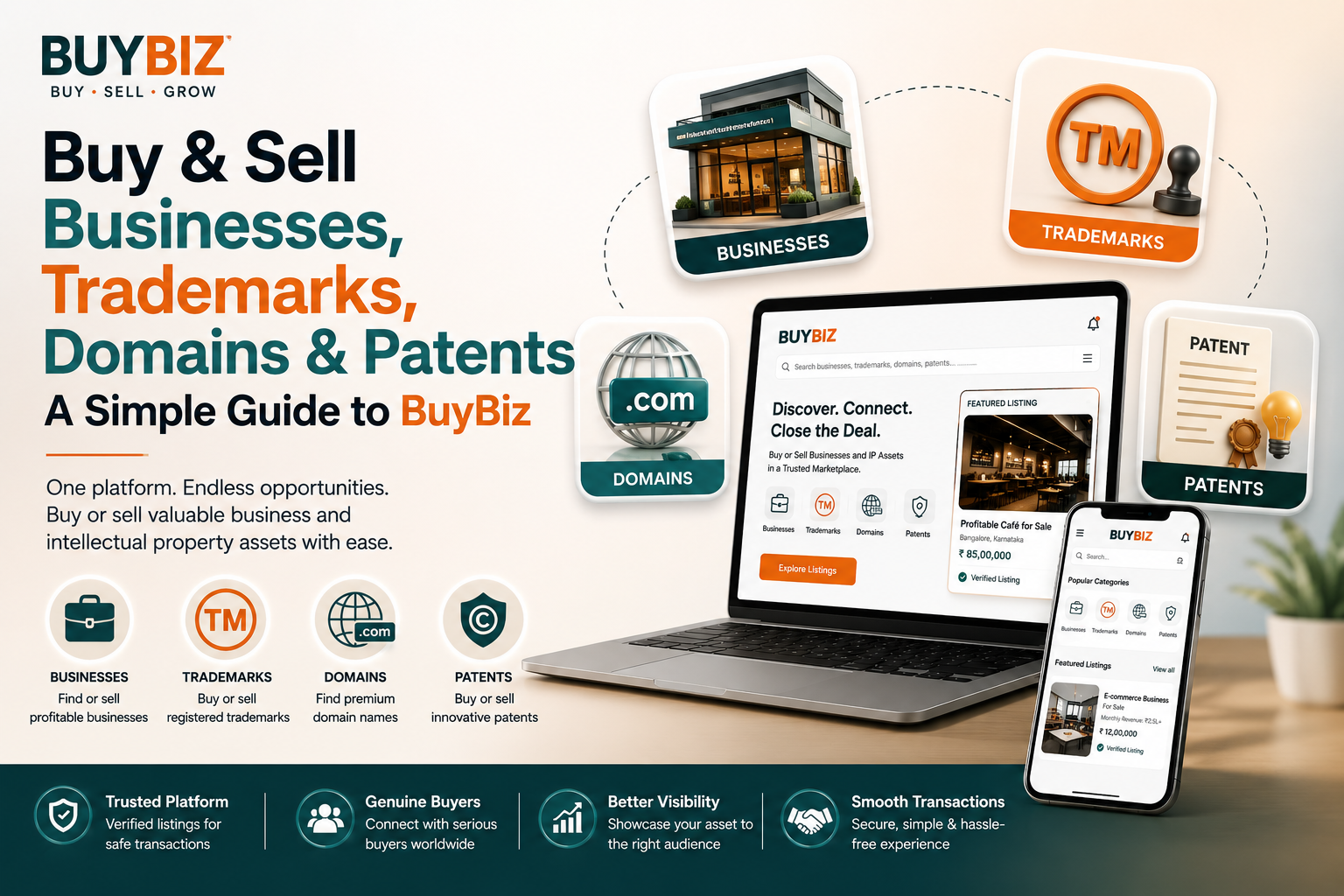
Buy & Sell Businesses, Trademarks, Domains & Patents: Try BuyBiz!
In today's fast-paced business world, buying and selling assets like businesses, trademarks, domain names, and patents can be a complex process. However, with the rise of online marketplaces, these transactions have become significantly more accessible and streamlined. Similar to the ease of buying and selling items on platforms like OLX, there are now dedicated platforms designed to facilitate the trade of business assets.
Key Features of These Platforms:
- User-Friendly Interface: Just like OLX, these platforms offer intuitive interfaces that make it easy for both buyers and sellers to navigate.
- Comprehensive Listings: Users can create detailed listings for their businesses, trademarks, domains, or patents, including relevant information, images, and pricing.
- Search Functionality: Buyers can search for specific assets based on various criteria, such as industry, location, or keywords.
- Secure Transactions: These platforms often employ secure payment gateways and escrow services to protect both buyers and sellers.
- Verification and Authentication: Some platforms require verification of sellers and assets to ensure legitimacy.
- Community and Networking: Many platforms foster communities where users can connect, share information, and seek advice.
Business Asset Trading: Here are a few notable examples:
- Platform for buying and selling businesses, franchises, and equipment. It offers a wide range of listings, including turnkey businesses and business opportunities.
- Specializes in the sale of websites and online businesses. It provides a marketplace for domains, WordPress sites, and other digital assets.
- Focuses on the buying and selling of domain names. It offers a vast inventory of domain names across various categories.
- Platform dedicated category for auction / sale / listing patents. It provides a transparent and efficient way for inventors and businesses to buy and sell patents.
Benefits of Using These Platforms:
- Efficiency: These platforms streamline the buying and selling process, saving time and effort for both parties.
- Global Reach: Users can connect with buyers and sellers from around the world, expanding their market reach.
- Transparency: The platforms often provide detailed information about assets, making it easier for buyers to make informed decisions.
- Accessibility: Anyone with an internet connection can access these platforms and participate in the trading of business assets.
In conclusion, the rise of online platforms has revolutionized the way businesses, trademarks, domains, and patents are bought and sold. Similar to the convenience of OLX, these dedicated platforms offer a user-friendly and efficient way to trade these valuable assets. By understanding the key features and popular platforms, you can leverage these tools to explore new business opportunities or sell your existing assets.
Explore BuyBiz - A One-Of-A-Kind Platform / App to Buy & Sell Businesses & IPR. All in one.
Tags