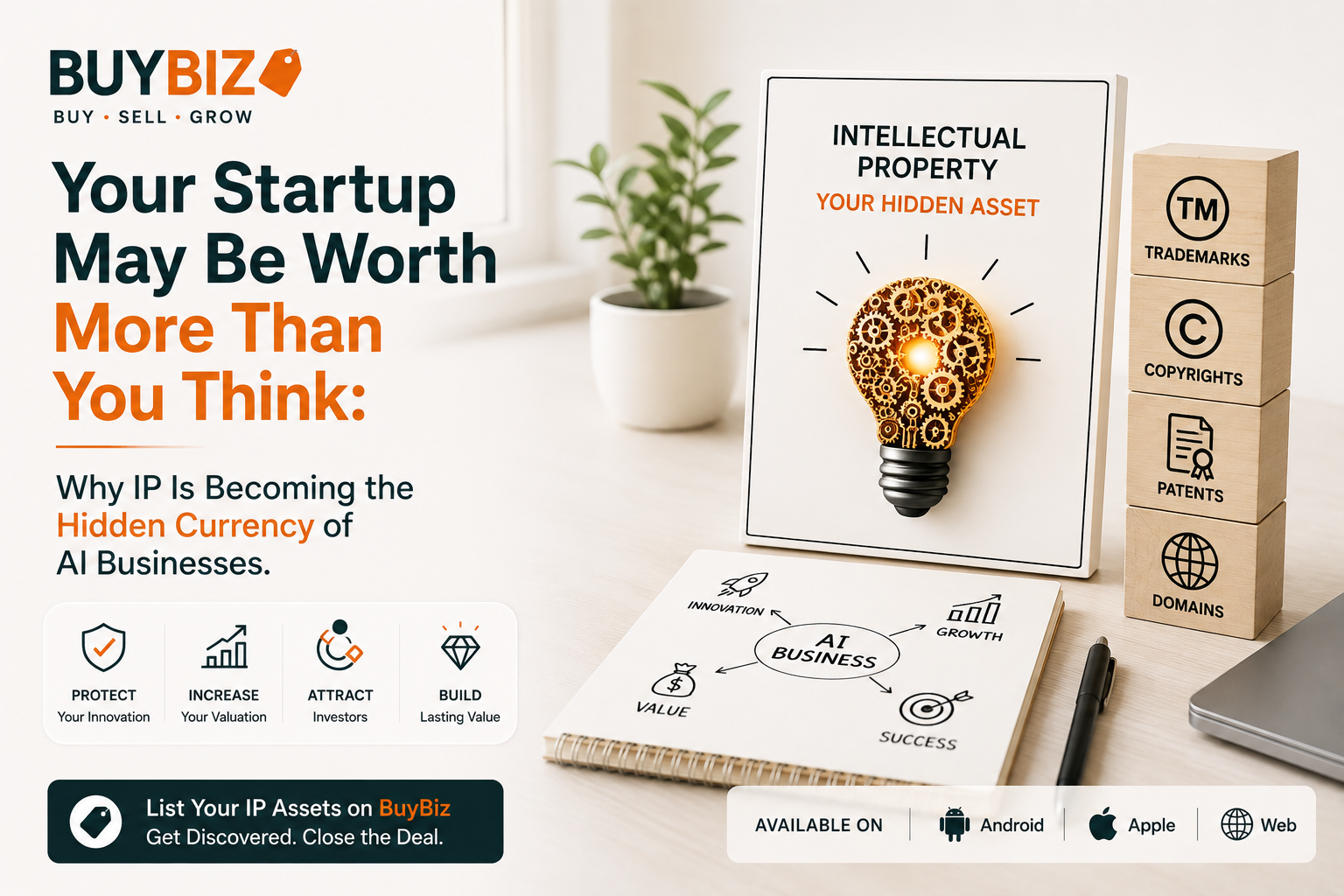
Your Startup May Be Worth More Than You Think: Why IP Is Becoming the Hidden Currency of AI Businesses

Imagine two startups.
Both have ₹5 crore in annual revenue.
Both have 20 employees.
Both have similar customers.
But there is one major difference.
Startup A owns its technology, trademark, software code, proprietary database and several valuable IP assets.
Startup B operates using third-party technology, has an unregistered brand, and has not properly documented ownership of the software created by its employees and freelancers.
Which company would an investor or acquirer prefer?
In many cases, Startup A.
And this is where an important shift is happening in the business world:
Intellectual Property is no longer just a legal asset. It is becoming a business asset, investment asset and M&A asset.
AI Is Making IP Even More Valuable
Artificial intelligence has accelerated the importance of intellectual property.
According to the World Intellectual Property Organization (WIPO), published GenAI patent families increased from around 14,000 in 2023 to more than 37,800 in 2025. WIPO also reported that more than 56,000 GenAI patent families were published during 2024 and 2025 combined.
This tells us something important.
Companies are not simply building AI products.
They are increasingly trying to own the technology behind those products.
That ownership can take different forms:
- Patents
- Trademarks
- Copyright
- Software
- Trade secrets
- Proprietary databases
- Algorithms and technical know-how
- Designs
- Domain names
- Licenses
- Proprietary processes
For an early-stage startup, these assets may not generate immediate revenue.
But they can become extremely valuable when the company raises funding, enters a strategic partnership or becomes an acquisition target.
Think of IP Like the "Property" of a Digital Business
Traditionally, businesses were valued based on physical assets.
A manufacturing company might own:
Land + Factory + Machinery + Inventory
A modern technology company may own:
Software + Brand + Data + Algorithms + Patents + Customer relationships
The second category may look less tangible.
But that doesn't mean it is less valuable.
In fact, for some technology businesses, the opposite can be true.
A startup may operate from a small office with 10 employees but own technology that took years to develop.
That technology can become the most valuable asset on the company's balance sheet from a commercial perspective—even if accounting rules do not reflect its full potential value.
A Simple Example
Let's say Rahul builds an AI-powered legal research platform.
He spends three years developing it.
The company owns:
Brand: "LexPilot"
Software: Proprietary legal research platform
Database: Structured legal information
Technology: Proprietary AI workflow
Trademark: Registered in relevant classes
Copyright: Software and original content
Trade Secrets: Internal processes and proprietary methods
The company generates only ₹1 crore in revenue.
Rahul thinks:
"My company is only worth ₹1 crore because my revenue is ₹1 crore."
An investor may think differently.
The investor may ask:
What exactly am I buying?
If the answer includes valuable proprietary technology, a defensible brand, documented IP ownership and scalable software, the investment story becomes much stronger.
This is why founders should not think of IP registration as simply a compliance exercise.
It is part of building enterprise value.
Why Investors and Acquirers Care About IP
When a company is being acquired, the buyer is not simply purchasing revenue.
The buyer may be purchasing:
- Technology
- Customers
- Brand
- Market access
- Patents
- Software
- Data
- Talent
- Licenses
- Contracts
- Distribution rights
- Intellectual property
This is why IP due diligence has become an important part of technology transactions.
An acquirer may ask:
Who owns the software?
Was it developed by employees?
Freelancers?
External developers?
A technology agency?
If a freelancer developed critical software but the contract does not properly transfer the relevant rights, the buyer may discover a serious ownership problem.
The Freelancer Problem
Consider another example.
A startup hires a developer to build its mobile application.
The developer creates 100% of the code.
The startup pays ₹5 lakh.
The founder assumes:
"I paid for it, therefore I own everything."
Not necessarily.
The contractual position matters.
A well-drafted agreement should clearly address ownership and assignment of relevant intellectual property rights, confidentiality, permitted use, and other applicable rights.
Now imagine the startup is being acquired for ₹50 crore.
During due diligence, the buyer asks:
"Show us the documents establishing ownership of your core software."
The company cannot produce them.
Suddenly, a seemingly small documentation issue becomes a ₹50 crore transaction issue.
This is why IP hygiene should start before a startup becomes valuable.
Your Trademark Can Also Become a Business Asset
Founders often treat trademarks as simply a way to prevent someone else from copying their name.
That's only one part of the story.
A strong brand can become one of the most valuable assets of a company.
Think about a consumer startup.
It may have:
- A registered trademark
- Strong social media presence
- Customer recognition
- Domain names
- Packaging designs
- Copyrighted content
- Distribution relationships
Even if the physical assets are limited, the brand itself can have significant commercial value.
This is particularly important in acquisitions.
A buyer may not want the founder's office.
The buyer may want the brand, customers, technology and IP.
IP Can Create Multiple Exit Opportunities
One of the most interesting developments is that founders don't always have to sell the entire company.
An entrepreneur may potentially explore different transactions involving IP, depending on the rights involved and the commercial structure.
For example:
1. Sell the entire business
The buyer acquires the company and its assets.
2. Sell specific IP
A company may explore selling a particular trademark, patent, copyright or other transferable IP asset.
3. License the IP
The owner retains ownership but allows another business to commercially use the IP in exchange for agreed consideration.
4. Strategic partnership
Two businesses may combine technology, IP and market access.
5. Acquire another business because of its IP
Sometimes the most attractive part of a small company may be its technology or IP rather than its current revenue.
This is one reason the market for buying and selling businesses and intellectual property is becoming increasingly interesting.
The Rise of the "IP-First" Startup
A traditional startup question is:
"How much revenue are you generating?"
An increasingly important question is:
"What do you own?"
Imagine two companies generating the same revenue.
Company A
- Unregistered brand
- Third-party software
- No clear IP assignment
- No patent strategy
- Weak contracts
- No IP inventory
Company B
- Registered trademark
- Proprietary software
- Clear employee/freelancer IP assignments
- Patent portfolio where commercially appropriate
- Documented trade secrets
- Strong licensing agreements
- Clear IP ownership records
Company B may be significantly easier to finance, partner with or acquire.
Revenue tells you what a business earns.
IP can tell you what a business owns and what competitive advantage it may be able to protect.
What Should Founders Do Today?
Every startup should consider creating an IP Asset Inventory.
Start with five questions:
1. What is our brand?
List trademarks, logos, taglines, domain names and important brand assets.
2. What technology do we own?
Identify software, source code, algorithms, databases, technical processes and inventions.
3. Who owns the IP?
Check employment agreements, consultant agreements, developer contracts, licenses and assignments.
4. What should remain confidential?
Identify trade secrets, proprietary information, business processes and confidential datasets.
5. Can our IP generate revenue?
Ask whether the IP could potentially be:
Licensed → Sold → Commercialized → Used in a partnership → Used to support an acquisition
This changes the way founders think about IP.
Instead of asking:
"Do I need to register this?"
Ask:
"Can this IP increase the value of my business?"
IP Is Moving From the Legal Department to the Boardroom
WIPO's 2026 initiatives specifically recognize that AI-driven startups need help identifying, protecting, managing and commercializing assets such as software, data, algorithms and inventions—and connecting IP strategy with investment, partnerships and international expansion.
That is a significant shift.
IP is increasingly becoming part of conversations around:
Fundraising
Startup valuation
Licensing
Joint ventures
Technology transfers
Mergers & acquisitions
International expansion
Business sales
The founder who understands this early may have a meaningful advantage.
The BuyBiz Perspective
At BuyBiz, we believe that businesses and intellectual property should not be viewed only as legal records.
They can be commercial assets.
A trademark may represent a brand.
A patent may represent technology.
A copyright may represent creative value.
A domain may represent digital identity.
A business may represent customers, technology, contracts and market opportunity.
And sometimes, the next big business opportunity is not starting something from zero.
It may be finding an existing business or IP asset and building on it.
That's the idea behind an IP and business marketplace.
Final Takeaway
The next generation of entrepreneurs will not only ask:
"How much money does my business make?"
They will also ask:
"What valuable assets have I built?"
Because in a technology-driven economy, the answer may include things that cannot be physically touched—but can influence investment, licensing, partnerships and acquisitions.
Your trademark.
Your software.
Your patent.
Your database.
Your technology.
Your brand.
Your know-how.
These can become part of your company's economic story.
And the earlier a founder starts treating IP as an asset rather than paperwork, the better positioned the business may be when the opportunity to raise money, expand, license, partner or sell eventually arrives.
Build the business. Protect the IP. Create the asset.
About BuyBiz
BuyBiz is a marketplace focused on buying, selling and discovering businesses and intellectual property assets, including trademarks, copyrights, patents and other business opportunities.
Whether you're an entrepreneur looking to acquire your next opportunity or a business owner looking to unlock value from an asset you've already created, the next opportunity may already exist.
Explore. Discover. Connect. Build.
Explore BuyBiz - A One-Of-Kind Platform / App to Buy & Sell Businesses & IPR. All in one.
Disclaimer: General info only. Seek professional advice before any transaction.
© 2026 BuyBiz. All Rights Reserved.
Popular Posts

No Popular Posts Found
We're sorry what you were looking for. please try another way